I am still new to this blogging thing and I am not sure whether the comments are easily visible to everybody. There was a really good point raised in the comments that I am going to paste up here so y'all can see it, along with my response. If you have now seen it twice, I apologize :)
The commenter said:
"Fascinating post. I wonder to what extent "terrior" can act as an inhibitor to creativity in the development of wines, foods and other products and services. Does it require that production methods, for example, must remain static."
Here is my response:
"That actually is an issue to which the book alludes. It seems to be more of a concern (though to its defendants it is probably not a concern) in places like France, where the "rules" can get fairly extensive. For example, to be eligible for an AOC designation, a winemaker must follow rules about the grape varietals that are grown, the density of growth, the geographic location of the vineyard, how the wine is produced, etc. There certainly are producers in France who use non-traditional approaches (and may produce very good results), but they do so outside the defined system. Stasis seems to be less of an issue within the U.S. because we don't have the same level of ingrained ideas about where and how certain things can be produced.
There is a very interesting second angle raised by this comment, however, which has to do with marketing. Producers have an incentive to clearly define their product and market it as unique in some way. In some cases, they are supported by governments or other organizations, but in others they may be largely self-designated. Creating the sense of distinctiveness necessarily excludes others who may be doing similar things in different places or using different methods; there is an incentive for producers to function such that they can use the marketing power of the defined "brand." Whether in France or the U.S., any producer operating outside a defined structure bears the burden of making his product known to consumers largely on his own.
I think that brings us to the key point that I took away from the book, which is that ultimately it is up to the consumer to be curious about the source of her food and look beyond the options that are most readily available. "
March 31, 2011

Off the Shelf: An Exploration of Food and Locality
I finally finished reading The Taste of Place: A Cultural Journey into Terroir by Amy B. Trubek. I bought the book months ago but never got around to reading it, and I am really glad I finally did. The book addresses the very amorphous concept of terroir. The traditional American translation equates terroir with, essentially, soil. The term is most often used when discussing wine, particularly the tastes typical of wines produced in certain areas. Trubek provides a significantly more nuanced interpretation of the term, both in terms of its original French meaning and its applicability in contemporary society.
The term terrior holds different meanings for different people. The broadest definition includes a recognition of the impact on the finished agricultural product of multiple factors, including environmental (geography, geology, and climate, for example) and human (production methods and cultural standards, for example) inputs. Essentially, food (and wine) tastes different based on where and how it is produced. The most strictly codified interpretation of terroir is evidenced in the French Appelation D'Origine Controlee (AOC) system. The system is intended to recognize and promote the uniqueness of certain products (originally wines, but now also foods) produced in defined areas using defined techniques. Attitudes towards and appreciation of terroir within France have been culturally ingrained; the country has hundreds of years of strong agricultural tradition that have established standards and practices for food and wine production, and there has also been a concerted effort on the part of the government to preserve the perceived uniqueness of French products.
The United States does not have nearly the same historical perspective on agriculture as France. Since the rise of commodity food production, the exploration of terroir in the US has largely been considered countercultural, and has been undertaken by fairly discrete groups of producers and consumers. The limited historical and cultural traditions regarding agriculture in the U.S. allows these individuals to be experimental and implement new techniques and practices while striving to make great tasting food and wine.
Trubek examines the concept of terroir along multiple dimensions, and highlights people and groups within both France and the United States that are working to maintain and develop this idea. The book includes extensive research and interviews, and the focus ranges from French winemakers to California winemakers to chefs in California, Wisconsin, and Vermont focused on using local ingredients (and the organization and logistics needed to make that happen) to Vermont maple syrup producers. The stories are compelling, and the book provides an incredible perspective on the breadth and nuance of flavors, as well as the human connections, that are available to us through food.
The term terrior holds different meanings for different people. The broadest definition includes a recognition of the impact on the finished agricultural product of multiple factors, including environmental (geography, geology, and climate, for example) and human (production methods and cultural standards, for example) inputs. Essentially, food (and wine) tastes different based on where and how it is produced. The most strictly codified interpretation of terroir is evidenced in the French Appelation D'Origine Controlee (AOC) system. The system is intended to recognize and promote the uniqueness of certain products (originally wines, but now also foods) produced in defined areas using defined techniques. Attitudes towards and appreciation of terroir within France have been culturally ingrained; the country has hundreds of years of strong agricultural tradition that have established standards and practices for food and wine production, and there has also been a concerted effort on the part of the government to preserve the perceived uniqueness of French products.
The United States does not have nearly the same historical perspective on agriculture as France. Since the rise of commodity food production, the exploration of terroir in the US has largely been considered countercultural, and has been undertaken by fairly discrete groups of producers and consumers. The limited historical and cultural traditions regarding agriculture in the U.S. allows these individuals to be experimental and implement new techniques and practices while striving to make great tasting food and wine.
Trubek examines the concept of terroir along multiple dimensions, and highlights people and groups within both France and the United States that are working to maintain and develop this idea. The book includes extensive research and interviews, and the focus ranges from French winemakers to California winemakers to chefs in California, Wisconsin, and Vermont focused on using local ingredients (and the organization and logistics needed to make that happen) to Vermont maple syrup producers. The stories are compelling, and the book provides an incredible perspective on the breadth and nuance of flavors, as well as the human connections, that are available to us through food.
March 30, 2011
On the Table: Veggie and Cheese Mini Empanadas with Spicy Dipping Sauce
I had a pound of dough in the refrigerator left over from making pizza the other day, so I decided to try making empanadas. I made a vegetable and cheese filling, since those are the ingredients I had on hand. They tasted a bit like mini calzones, but they were delicious either way! To prepare:
Make the Filling
Thinly slice one medium white onion. Clean and slice three ounces of mushrooms (I used baby portobellos).

In a large pan, heat up a tablespoon of butter and a splash of olive oil. When the pan is warm, add in the onions. Cook, stirring, until the onions start to get tender. Add in the mushrooms. When the mushrooms start to brown, add in about half a pound of spinach (I used frozen chopped spinach since I had some in the freezer, but you could certainly use fresh; you would just need to clean it and chop it up first). Add in 1/2 a teaspoon of cayenne pepper, 1/4 teaspoon cumin, 1/8 teaspoon coriander, 1/8 teaspoon celery seed, 1/8 teaspoon ground ginger and 1-2 teaspoons salt. Continue cooking until all ingredients are cooked through. Adjust seasoning to taste.

You will want the filling to be cool and fairly dry before you use it. I put a colander inside a mixing bowl, and put the filling in the colander. I left it in the refrigerator for about half an hour.

When you are prepared to assemble the empanadas, mix about a cup of shredded cheese into the vegetables (I used a mix of mozzarella and cheddar).
Make the Empanadas
Preheat the oven to 350 degrees.
Roll out the dough (I worked with just half a pound of dough at a time so it was a little more manageable). Make sure the work surface is well floured. Roll the dough out to approximately 1/8 of an inch thick. To make the mini empanadas, use a large biscuit cutter (about 3.5 inches in diameter) to cut them out. Then, roll the circles out further, until they are about 4.5 inches in diameter.

Fill each circle with a heaping tablespoon of the filling. Fold the circle in half, and crimp around the edge to seal. Thoroughly beat together an egg and a few drops of cold water to make an egg wash, and brush the top and sides of each empanada with the egg wash.

Bake in the preheated oven for 25-30 minutes, or until the empanadas are golden brown.

While the empanadas are cooking, you can prepare any sauces or accompaniments. I made a spicy dipping sauce by combining equal parts sriracha, honey, and dijon mustard (I used about a tablespoon of each). It was SPICY, but delicious!
Enjoy!
Make the Filling
Thinly slice one medium white onion. Clean and slice three ounces of mushrooms (I used baby portobellos).

In a large pan, heat up a tablespoon of butter and a splash of olive oil. When the pan is warm, add in the onions. Cook, stirring, until the onions start to get tender. Add in the mushrooms. When the mushrooms start to brown, add in about half a pound of spinach (I used frozen chopped spinach since I had some in the freezer, but you could certainly use fresh; you would just need to clean it and chop it up first). Add in 1/2 a teaspoon of cayenne pepper, 1/4 teaspoon cumin, 1/8 teaspoon coriander, 1/8 teaspoon celery seed, 1/8 teaspoon ground ginger and 1-2 teaspoons salt. Continue cooking until all ingredients are cooked through. Adjust seasoning to taste.

You will want the filling to be cool and fairly dry before you use it. I put a colander inside a mixing bowl, and put the filling in the colander. I left it in the refrigerator for about half an hour.

When you are prepared to assemble the empanadas, mix about a cup of shredded cheese into the vegetables (I used a mix of mozzarella and cheddar).
Make the Empanadas
Preheat the oven to 350 degrees.
Roll out the dough (I worked with just half a pound of dough at a time so it was a little more manageable). Make sure the work surface is well floured. Roll the dough out to approximately 1/8 of an inch thick. To make the mini empanadas, use a large biscuit cutter (about 3.5 inches in diameter) to cut them out. Then, roll the circles out further, until they are about 4.5 inches in diameter.

Fill each circle with a heaping tablespoon of the filling. Fold the circle in half, and crimp around the edge to seal. Thoroughly beat together an egg and a few drops of cold water to make an egg wash, and brush the top and sides of each empanada with the egg wash.

Bake in the preheated oven for 25-30 minutes, or until the empanadas are golden brown.

While the empanadas are cooking, you can prepare any sauces or accompaniments. I made a spicy dipping sauce by combining equal parts sriracha, honey, and dijon mustard (I used about a tablespoon of each). It was SPICY, but delicious!
Enjoy!
March 29, 2011
On the Table: Stuffed Dates with Prosciutto
To go along with Brussel Sprouts with Prosciutto, I made dates wrapped in prosciutto. I made some plain, but I also decided to stuff some and bake them. The results were delicious, and this might become a new go-to appetizer - or honestly, I would serve them for dessert! To prepare:
Preheat oven to 350 degrees. Cut open twelve Medjool dates (just cut halfway through) and remove the pits. Stuff each date with about 1/4 teaspon of cream cheese and a drop of honey. Cut four slices of prosciutto into thirds lengthwise. Wrap a strip of prosciutto around each date. Put in the preheated oven for 6-8 minutes, or until the dates are warmed through and the prosciutto gets crisp. Serve warm.

I used cranberry pepper jelly as a dipping sauce, and it was delicious. Enjoy!
Preheat oven to 350 degrees. Cut open twelve Medjool dates (just cut halfway through) and remove the pits. Stuff each date with about 1/4 teaspon of cream cheese and a drop of honey. Cut four slices of prosciutto into thirds lengthwise. Wrap a strip of prosciutto around each date. Put in the preheated oven for 6-8 minutes, or until the dates are warmed through and the prosciutto gets crisp. Serve warm.

I used cranberry pepper jelly as a dipping sauce, and it was delicious. Enjoy!
On the Table: Brussels Sprouts with Prosciutto
I had some Brussels sprouts in the refrigerator today, and it seemed that everywhere I looked (on the internet, at least), I was seeing recipes for Brussels sprouts, so I decided to do some experimenting.

I also had prosciutto in the refrigerator, so I decided to try a play on the standard of Brussels sprouts with bacon. I think I liked them better with the prosciutto! To make this fabulous dish:
Prepare a pound of Brussels sprouts. Rinse them, cut off the ends, and discard any leaves that look unappetizing (e.g., they have black spots or insect bite holes). Cut the Brussels sprouts into quarters (or halves, if they are small).

Dice up three slices of prosciutto into small pieces. Put the prosciutto in a big, COLD skillet (it needs to be a skillet with a lid). Put the skillet over low heat and render out as much of the fat as possible. When the prosciutto starts to get cripy and most of the fat has been rendered, remove it from the skillet. Add one and a half tablespoons of butter to the pan (you want enough fat to coat the bottom of the pan, so adjust based on the amount of fat that was rendered from the prosciutto), turn the heat up to medium, and allow the butter to get hot. Add in the Brussels sprouts. Allow them to cook for a few minutes, stirring frequently. Season with salt and black pepper (but go easy on the salt, since the prosciutto will add a lot of salt). When the leaves have started to wilt, add in a cup of chicken stock and a tablespoon of balsamic vinegar. Bring the liquid to a simmer, cover the skillet, and turn down the heat. Allow to cook for 10-15 minutes. For the last five minutes of cooking, remove the lid to allow the liquid to evaporate. The Brussels sprouts are done when they are very tender. Add the prosciutto back into the pan and stir to combine. Serve warm.
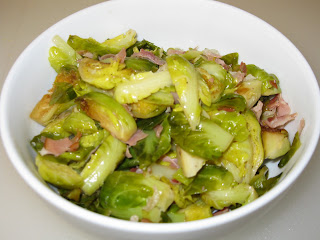
Enjoy!

I also had prosciutto in the refrigerator, so I decided to try a play on the standard of Brussels sprouts with bacon. I think I liked them better with the prosciutto! To make this fabulous dish:
Prepare a pound of Brussels sprouts. Rinse them, cut off the ends, and discard any leaves that look unappetizing (e.g., they have black spots or insect bite holes). Cut the Brussels sprouts into quarters (or halves, if they are small).

Dice up three slices of prosciutto into small pieces. Put the prosciutto in a big, COLD skillet (it needs to be a skillet with a lid). Put the skillet over low heat and render out as much of the fat as possible. When the prosciutto starts to get cripy and most of the fat has been rendered, remove it from the skillet. Add one and a half tablespoons of butter to the pan (you want enough fat to coat the bottom of the pan, so adjust based on the amount of fat that was rendered from the prosciutto), turn the heat up to medium, and allow the butter to get hot. Add in the Brussels sprouts. Allow them to cook for a few minutes, stirring frequently. Season with salt and black pepper (but go easy on the salt, since the prosciutto will add a lot of salt). When the leaves have started to wilt, add in a cup of chicken stock and a tablespoon of balsamic vinegar. Bring the liquid to a simmer, cover the skillet, and turn down the heat. Allow to cook for 10-15 minutes. For the last five minutes of cooking, remove the lid to allow the liquid to evaporate. The Brussels sprouts are done when they are very tender. Add the prosciutto back into the pan and stir to combine. Serve warm.

Enjoy!
Subscribe to:
Posts (Atom)